

The Circular Shift
The Circular Shift
Why the future of tech lies in smarter design, longer lifespans and new ownership models.
Repair instead of discard, rent instead of own: circular tech brings entirely new perspectives to the home and consumer tech sector. At IFA 2025, manufacturers and the NGO Cradle to Cradle will demonstrate how the circular economy can become a driver of economic innovation – and why a new understanding of design is crucial.
Author: Olga Blumhardt
Illustrator: Antimimosa
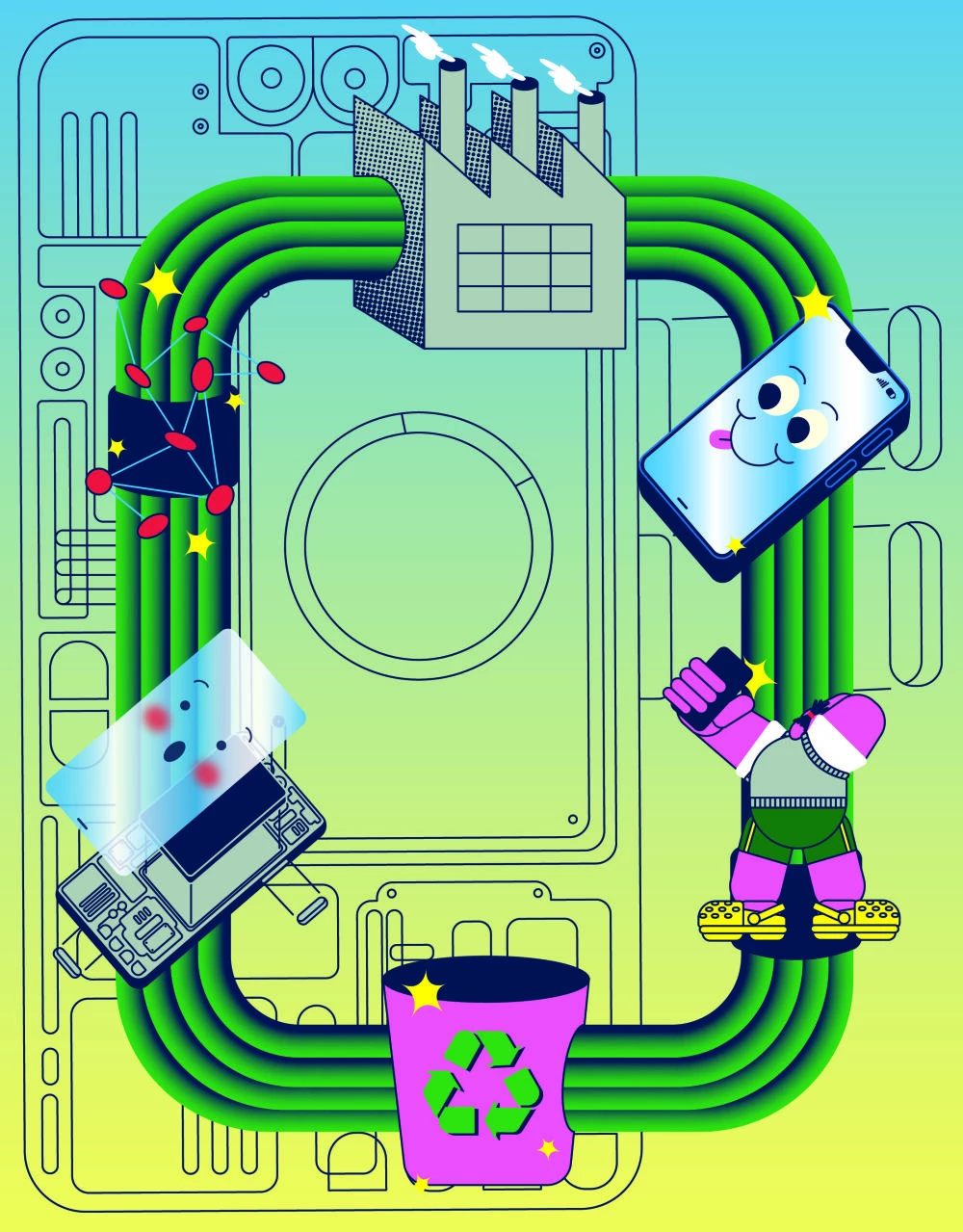
A device that doesn’t break but can be taken apart. A washing machine that isn’t bought but rented. A fridge that doesn’t end up as e-waste, but can be split into its individual components, ready for a second life. Circular tech – with its focus on repairability, modular design and new business models like leasing – is stepping into the spotlight at IFA 2025.
This shift comes with a change in mindset. Instead of asking how to recycle a product at the end of its life, the circular economy starts at the beginning – with design. “If we design a product to be recyclable from the outset, we eliminate waste entirely,” say Nora Sophie Griefahn and Tim Janssen, founders of Berlin-based NGO Cradle to Cradle. This year, they are official cooperation partners of IFA – hosting panels, workshops and a joint position paper that not only calls for rethinking, but actively inspires implementation.
The principle is simple but uncompromising: every material used must be able to return into circulation without loss of quality, toxic residues or extra costs. In reality, the industry often falls short. “The problem isn’t recycling,” says Janssen. “The problem is the design that makes recycling impossible.”
Pioneers are already showing that another way is possible. Companies like Shift Phones and Liebherr are working with modular components, prioritising repairability and transparent supply chains. Manufacturers such as Miele and BSH are creating long-lasting appliances, some offered through return or rental models. The advantage: when companies provide access to a product rather than selling it outright, they have a direct interest in making it durable and recyclable. “Suddenly, quality pays off twice,” says Griefahn. “For the company – and for the environment.”
Politically, momentum is building. The EU is introducing new product standards, and the “Right to Repair” law now requires manufacturers to fix devices even after the warranty period – at fair prices and with accessible spare parts. For many in the industry, this marks a paradigm shift as technology, business models and distribution strategies all need to adapt. “The biggest challenge is often understanding your own product,” says Janssen. “Where do the materials come from? How can they be recovered? And what happens next?”
These questions will be at the heart of IFA 2025 – not as a challenge to innovation, but as an expansion of it. “Technology doesn’t have to be less – it just has to be better,” says Griefahn. Circular-ready devices require planning, time and new logistics, but they also create resilience – a crucial advantage in an era of resource scarcity and global supply chain risks.
Circular tech does not mean going backwards. It means moving forward – with a system. With products that are repaired, updated or passed on rather than replaced. With materials that are reused rather than discarded. It’s about all stakeholders – including consumers – recognising this responsibility not as a burden, but as an opportunity. “What’s considered niche today will be the norm tomorrow,” says Janssen. “We want to inspire change, show that transformation is possible and meaningful – and that it creates value. IFA is the perfect stage because it brings together innovation, industry and consumers.”
About Cradle to Cradle
Founded in 2012 by Nora Sophie Griefahn and Tim Janssen, the NGO Cradle to Cradle has a clear mission: to design products and processes to prevent waste. Rather than pursuing efficiency at all costs, the organisation calls for a radical rethink – inspired by nature, where everything becomes a nutrient for something new.
Today, C2C operates from its LAB in the heart of Berlin, coordinating more than 50 volunteer initiatives and maintaining a broad network of partners from business, politics and science. It organises the annual C2C Congress – the world’s largest platform for circular innovation – and leads transformation projects such as the “Labor Tempelhof” concert series featuring bands like Die Ärzte and Die Toten Hosen. In 2025, the NGO is partnering with IFA Berlin for the first time.

Discover At IFA 2025
Panels, keynotes, discussions and the new position paper on making circular tech a reality.
Programme Highlights:
- Serving the Consumer, Preserving the Planet – Electrolux Group
5 Sept, 14:15, Innovation Stage - Right to Repair: A 360° Industry View – Wertgarantie & Handelsverband Technik
6 Sept, 16:15, Dream Stage - AI, Built – Tuya
8 Sept, 14:30, Dream Stage - Scene Setter: The Future of Sustainability – WGSN
9 Sept, 10:45, Dream Stage - The Future of Impact: AI for a Sustainable & Inclusive World – Impact Hub Berlin
9 Sept, 14:30, Dream Stage